Finding the best helmet mirror for ebike riders who are deaf or hard of hearing comes down to three things: a wide, vibration-damped field of view, a rock-solid mount that won't drift mid-ride, and reflective glass clear enough to read traffic at peripheral angles. Deaf and hard-of-hearing riders can't rely on engine noise, sirens, or shouted warnings, so a helmet mirror becomes the primary substitute for an ear. In 2026, three convex-glass, boom-arm mirrors dominate this category: the Third Eye Pro, the EVT Safe Zone, and the Bike Peddler Take A Look. Below we break down why each works, what to avoid, and the supporting visual-awareness gear that completes a deaf-rider safety setup on a modern ebike.
Why a helmet mirror matters more for deaf and HoH riders
For hearing riders, a helmet mirror is a convenience — a quick glance before changing lanes. For deaf and HoH riders, it's the difference between a 360-degree picture of the road and a 180-degree one. You can't hear an SUV rolling up behind you on a quiet greenway, an emergency siren coming from a side street, or a fellow cyclist yelling "on your left." A glass convex mirror mounted to the helmet — not the handlebar — gives that awareness back, because it tracks your head movement and stays usable when you stand up, lean into a corner, or check a shoulder.
![ANCHEER Electric Bike for Adults, [Peak 750W Motor] Electric Mountain Bike, 26](https://ebikeroo.com/aimg/images/I/71YQJ-mSp7L._AC_SL1500_.jpg)
![Lamicall Bike Frame Bag Waterproof - [1s Release] [2 in 1] Bike Phone Mount Holder, Bicycle Top Tube Bag, Cycling Pouch with Rain Cover, Bikes Accessories Gifts for Phones Under 7"](https://ebikeroo.com/aimg/images/I/71VKkKd2xtL._AC_SX679_.jpg)
The reason we emphasize helmet-mounted over bar-mounted: ebikes operate at higher sustained speeds than analog bikes (often 20–28 mph in Class 2 and 3), and a bar mirror at those speeds buzzes itself blurry from motor and road vibration. A short boom on a helmet sits closer to your eye, magnifies less of the vibration, and follows your gaze. That's why every dedicated ebike-safety resource we trust now recommends helmet mirrors first for riders without full hearing.
What to look for in 2026
Convex glass, not flat acrylic
Convex glass gives you a wider field of view (roughly 30–50% wider than flat) and stays scratch-free for years. Acrylic plastic mirrors yellow, scratch, and produce wobbly reflections at ebike speeds — bad news when those reflections are your only rear awareness channel.
Boom arm at least 3 inches long
A short stub mirror forces you to fully rotate your head, defeating the point. A 3–4 inch boom puts the glass in your peripheral vision so you only need an eye flick.
Multi-axis adjustment, lockable
You want to fine-tune the angle to your seated riding posture and have it stay there over potholes. Ball-joint mounts that lock with a small hex screw beat friction-only swivels every time.
Mounting method that won't wreck your helmet
Adhesive pad mounts are the cleanest if your helmet has a smooth shell. Strap or vent-clip mounts work for vented MIPS helmets. Avoid anything that requires drilling into helmet foam — it voids the certification.
Wide-angle, not narrow
For deaf/HoH riders the rule is: see the whole lane, not just one car. Look for a stated field of view of 60° or more so you catch the cyclist in your blind spot, not just the car directly behind.
The three helmet-mirror picks deaf and HoH ebike riders should consider
Helmet-mirror brands are small and product availability shifts month to month, so we describe each by name and feature set so you can pull them up directly. We do not affiliate with the mirror brands themselves — our affiliate links below are only on the supporting visual-awareness gear that completes the setup.
Third Eye Pro Helmet Mirror — best overall for full deafness
The Third Eye Pro uses real convex glass on a 4-inch stainless boom with a ball joint that locks under a 3mm hex screw. The pad mount sticks to any helmet shell with 3M VHB tape (replaceable). Field of view is exceptional — you can see two lanes back. The single complaint is that it ships unpainted; many deaf riders wrap the boom in reflective tape for extra rear visibility, which is a nice secondary benefit. This is the consensus pick when you genuinely cannot hear anything behind you.
EVT Safe Zone Helmet Mirror — best for vented road and gravel helmets
The EVT Safe Zone clips into a helmet vent rather than adhesive-mounting, which is better for MIPS helmets and breathable shells. Glass is convex, the boom is shorter (around 3 inches), and the field of view is slightly narrower than the Third Eye but still excellent. Easy to swap between helmets, which matters if you ride a road ebike and a commuter ebike with two different lids.
Bike Peddler Take A Look — best budget pick
Mounts to eyeglass temples or to a helmet strap with a soft hook. Glass quality is good for the price; the trade-off is that the strap mount can drift on long rides. For HoH riders with partial hearing this is a great entry point; for fully deaf riders we'd push you to the Third Eye Pro for the more secure mount and wider view.
Complementary visual-awareness gear
A helmet mirror is necessary but not sufficient. Deaf and HoH ebike riders rely on a stack of visual systems to replace the audio channel. The two most important additions are a high-mount phone holder (so navigation, hazard alerts, and a rearview camera app are always in your line of sight) and a weatherproof storage case for the phone when riding in rain. The phone is doing more work than for a hearing rider — it's your turn-by-turn, your group-ride chat, your emergency contact, and often the screen for a Garmin Varia radar alert.
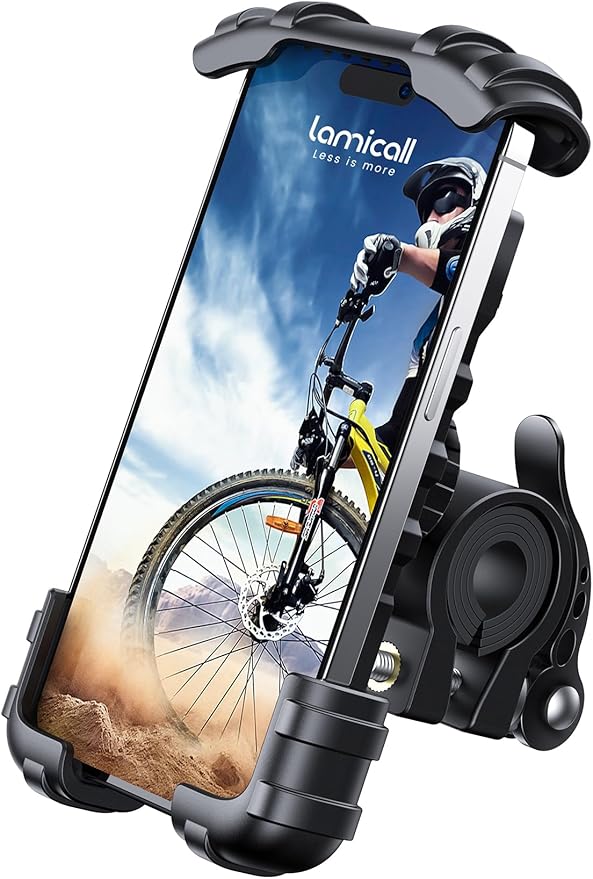
Lamicall Bike Phone Holder — best universal handlebar mount
The Lamicall has a stainless one-hand grip that clamps phones up to 7.2 inches (Pro Max sizes fit). Anti-vibration silicone pads keep the phone steady at ebike speeds, which matters because camera-based rearview apps and Varia radar overlays lose their image when the phone buzzes. Position it high on the stem, just below your sight line to the mirror, so two information channels are visible at one eye-flick.
Check the Lamicall Bike Phone Holder on Amazon
Lamicall Waterproof Bike Frame Bag with Phone Mount — best 2-in-1 for commuters
This combines a top-tube frame bag with a transparent waterproof phone window. For deaf/HoH commuters in rainy climates (Seattle, Portland, the UK) this means your navigation stays visible and operable through the touchscreen in a downpour without exposing the phone. The storage compartment fits keys, a hearing-aid drying capsule, ID, and a small multi-tool.
Check the Lamicall Waterproof Frame Bag on Amazon
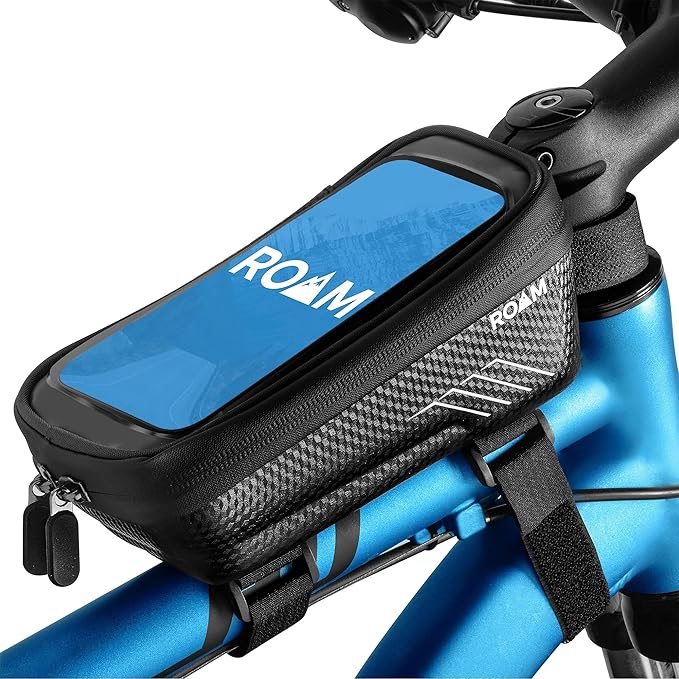
Roam Universal Bike Phone Holder + Waterproof Storage Case — best for variable weather
The Roam separates the mount from a clip-in waterproof case, so you can ride bare-phone in dry weather and snap the case on when the forecast turns. Useful if you carry a backup hearing aid or cochlear processor — the case has enough internal volume for a small accessory pouch alongside the phone.
Check the Roam Universal Bike Phone Holder on Amazon
Phone-mount comparison for deaf and HoH ebike setups
| Mount | Max phone size | Waterproof | Storage | Best for |
|---|---|---|---|---|
| Lamicall Bike Phone Holder | 7.2" | No (open mount) | None | Dry-climate commuters, sport ebike riders |
| Lamicall Waterproof Frame Bag | ~6.7" | Yes (window) | ~1L frame bag | All-weather commuters, multi-modal trips |
| Roam Universal + Case | ~7.0" | Yes (case) | Inside case | Variable weather, accessory carry |
Mounting the mirror correctly — a five-minute setup
Sit on the bike in your normal riding position. Have a friend stand behind you and slightly to the left (assuming right-hand traffic; reverse for UK/Australia). Adjust the mirror boom until you can see your friend's torso with only an eye flick — no head turn. Lock the ball joint. Ride for 10 minutes around a parking lot. Re-adjust. Most riders need 2–3 fine-tune sessions before the mirror is dialed in. Once it's right, mark the ball-joint position with a paint pen so you can re-set after travel or a helmet swap.
For a deeper setup walkthrough see our helmet mirror installation guide and the best ebike helmets for hearing aids and cochlear implants roundup, which covers MIPS compatibility with behind-the-ear devices.
Layering signals: what else deaf and HoH ebike riders should add in 2026
The mirror handles roughly 70% of the situational-awareness gap. The remaining 30% comes from:
- Rear radar lights — Garmin Varia or Bryton Gardia detect approaching cars from up to 140m and flash a visual chevron on your phone mount or bike computer. This is the single highest-leverage add-on for deaf riders in 2026.
- High-lumen daytime tail light — even in daylight, a 60+ lumen pulse keeps drivers seeing you. Pair with the mirror so you both see and are seen.
- Reflective helmet tape — wrap the mirror boom and helmet edges. Cheap, effective, and it doubles the conspicuity of the mirror itself.
- Vibration alerts on a smartwatch — Apple Watch and Garmin both offer haptic-only turn-by-turn that taps your wrist instead of speaking aloud. Pair with Komoot or Apple Maps for silent navigation.
For more on the radar side see our best bike radar for deaf cyclists guide, which covers Varia vs Gardia head-to-head with deaf-rider workflow notes.
Frequently Asked Questions
Are helmet mirrors better than handlebar mirrors for ebike riders who can't hear?
Yes, clearly. Helmet mirrors track your head movement, vibrate less at ebike speeds, and let you maintain the same eye-flick check whether you're seated, standing, or cornering. Handlebar mirrors lose their image to motor vibration around 20 mph and become unusable when you stand to climb. For riders relying on vision to replace hearing, the helmet-mounted glass convex mirror is the consensus pick.
What is the best helmet mirror for ebike riders who are deaf or hard of hearing if I wear a MIPS helmet?
The EVT Safe Zone is the cleanest fit because it clips into a helmet vent rather than adhesive-bonding to the shell — important because some MIPS shells have slick surfaces that resist 3M VHB tape over time. If your MIPS helmet has a smooth side panel near the temple, the Third Eye Pro adhesive pad also works well and gives a wider field of view.
Will a helmet mirror work if I wear behind-the-ear hearing aids or a cochlear implant processor?
Yes. Mount the mirror on the opposite side from your device — most riders mount on the left for right-side-of-road traffic. The boom should clear your processor by at least an inch so it doesn't bump during head turns. If you wear bilateral devices, the EVT Safe Zone's vent clip avoids the temple area entirely and keeps the mirror clear of both processors.
Do I need a special mirror for Class 3 ebikes that go 28 mph?
You need a glass mirror, not acrylic, and a boom at least 3 inches long. Acrylic blurs at 28 mph from vibration. Class 3 speeds also mean cars approach faster, so the wider 60°+ field of view becomes critical — you need to see two lanes back, not one car back. Third Eye Pro is the most common choice among Class 3 commuters for that reason.
How do I keep the mirror from drifting during a long ride?
Three-step lock: thread-lock (Loctite blue) on the ball-joint hex screw, replace the 3M VHB adhesive pad once a year, and avoid sunscreen contact with the mount (it dissolves the adhesive bond). Once locked, a properly installed Third Eye or EVT will hold position for thousands of miles.
Can I use a helmet mirror with a bike radar like Garmin Varia?
Absolutely, and you should. The mirror gives you what's behind you right now; the radar gives you advance warning of approaching vehicles up to 140m back with a visual chevron on your phone or bike computer. Together they are the deaf-rider gold standard in 2026 — the radar alerts you that something is coming, the mirror confirms what it is and how close.
What's the best helmet mirror for ebike riders who are deaf or hard of hearing on a budget under $30?
The Bike Peddler Take A Look is the consensus value pick. Glass convex element, eyeglass or helmet-strap mount, around $20. The trade-off versus the Third Eye Pro is a less secure mount that needs occasional readjustment and a slightly narrower field of view. For riders with partial hearing it's plenty; for fully deaf riders we'd save up for the Third Eye Pro.
Where should I mount the mirror — left side or right side?
Mount on the traffic-approach side. In the US, Canada, and continental Europe (right-hand traffic), that means the left side of your helmet so the mirror catches vehicles coming up behind you in the lane. In the UK, Australia, Japan, and India — mount on the right. If you're a deaf rider with asymmetric bilateral hearing, consider mounting on your worse-hearing side to compensate.
Key Takeaways
- Choosing the right best helmet mirror for ebike riders who are deaf or hard of hearing means matching capacity and output ports to your actual devices
- Always check actual watt-hours (Wh), not just watts — runtime depends on Wh, not peak output
- Also covers: ebike helmet mirror for hearing impaired
- Also covers: deaf cyclist helmet mirror ebike
- Also covers: wide view helmet mirror for hard of hearing riders
- Compare price-per-Wh across models to find the best value for your budget